Thursday, May 13, 2010


Tuesday, May 4, 2010
Monday, May 3, 2010
iCITIZEN in Macau

Hi again! I didn't realize that i have not been updating my blog since when. My last post was about my Bali Trip with the boys. So many things have happened and i jot it down most in my Twitter and Facebook.
iCitiz
 en project has been wonderful, but very taxing on me and my team. Finally we got something going on a global basis, our very own Certification and content for the world.
I was at Certiports APAC Meeting in Macau last March, and had wonderful time meeting the people and had the opportunity to present the concept and idea to the world. The feedback has been outstanding!
Here we come WORLD
AIM 2010

I am not so much into music, but yesterday's AIM 2010 caught my eyes and attention...of course due to Yuna, Aizat and Faizal Tahir...plus the great Afdlin & Co and the band. The rest are just side shows. Here's a tribute to the best song of the year!
AIM 17 - SONG OF THE YEAR
http://www.youtube.com/watch?v=yEwZb_lxo6A
Friday, November 27, 2009
Great Time in Tembok, Bali

Hi again, its writing time again. Been planning this trip months ago. I wanted to celebrate our 24th Anniversary in Bali...just the two of us. But as planning continues, more feedback need to be considered. True enough, we owed Muiz a holiday trip for his good result in last years PMR. So Muiz is on, during this school break holiday. Now there is three of us, booked on a bargain air fare to Denpasar.

Monday, November 2, 2009
40th Anniversary of the First ARPANET Transmission

New interviews with pioneers Duvall and Kline will be made available on October 29 on www.computerhistory.org, along with links to other resources. This will kick off a series of Computer History Museum activities on the history of the Internet and the Web.
"The 1969 connection was not just a symbolic milestone in the project that led to the Internet, but in the whole idea of connecting computers—and eventually billions of people—to each other," said Marc Weber, founding curator of the Museum's Internet History Program. "In the 1960s, as many as a few hundred users could have accounts on a single large computer using terminals, and exchange messages and files between them. But each of those little communities was an island, isolated from others. By reliably connecting different kinds of computers to each other, the ARPANET took a crucial step toward the online world that links nearly a third of the world's population today."
"The development of the ARPANET, which had no commercial application at the time, underscores the power of coordinated basic research and the importance of that research to our society," said Bill Duvall. "In the 1960s, computers were not interconnected and most were not even interactive. A few research groups were looking at the potential of networked computing and how distributed systems might be used as information repositories and collaboration tools, but they were hampered by a huge obstacle: they lacked a network to weave their projects together. Bob Taylor and Larry Roberts at ARPA understood not only the potential of computer networking, but also the challenge of networking during an era when computers were generally not standardized, and did not use a common language or alphabet."
"The ARPANET was built to permit ARPA-supported computer researchers to share common interests without geographical limits," said Bob Taylor, who helped conceive and fund the ARPANET in the mid 1960s as head of computing research at ARPA (U.S. Department of Defense Advanced Research Projects Agency). Taylor and his Program Manager Larry Roberts chose the people and places to build the network, assigning unique roles to three institutions: Cambridge-based BBN built the special Interface Message Processors (IMPs) that connected the main computers to the net and served as the system's administrator; SRI was the Network Information Center, which besides acting as a central library kept track of all the computers on the net and ran the Domain Name System until 1991; and UCLA was the Network Measurement Center, researching and improving how data moved across the network. An original BBN Interface Message Processor (IMP) computer is in the Computer History Museum's collection.
By early 1970, those three Centers were all connected, along with the University of California at Santa Barbara and the University of Utah. By 1972, the network had 37 nodes. A few years later, the ARPANET would begin the process of connecting itself to other networks that had sprung up—a process known as internetworking—leading to the Internet on which the World Wide Web and email run today. Both SRI and BBN played key roles in internetworking, and SRI's mobile radio van was used in several watershed experiments. The van is now a part of the Computer History Museum's collection.
Sunday, October 4, 2009
Utah Trip

I just can't imagine what Utah is like. When i was asked to go for this working trip i wasn't know what to aspect. I have relatively a good idea what's to come professionally, that is lots of work to deal with our new partner based in American Fork, Utah ( a world renown Certification company), but the least of what Utah would be like?
Wednesday, September 23, 2009
Eid -ul-Fitr Celebration
| |

Tuesday, September 22, 2009
End of Ramadhan, Welcome Syawal and Hello Utah
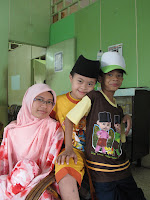 n. I had to break fast in my car three times over the month just to indicate how much work we need to finish off before Syawal, making me late to leave office and be on time for breakfasting. Off late the weather didn't help either, raining almost every afternoon, making driving home takes longer time than usual, i.e more than an hour an a half from Cyberjaya to Setapak Indah. At least the work on OeC has produced fruits and we are packaging it for the Utah trip.
 Sunday, September 13, 2009
Hong Kong named world's spam capital

Again we get to see and hear more and more of this abuse of the Net by unethical people. It gives you the creep of what is going to happen as more and more people taking on the cyber world without any sense of good ethics, self respect and respect of others. Cyber world provides the platform for people to express themselves to a larger world and audience that never before possible. It also provides the 'shade' from prying eyes of their true identity thus making them feel brave to do things that they 'knowingly' know would adversersely affect others and unintentionally gain them the title "World's Spam Capital"
HONG KONG (AFP) - - Hong Kong is under siege from legions of "zombies" attacking people with spam and leaving in their wake a trail of destruction costing millions of dollars a year, analysts have warned. It sounds like the plot of a surrealist B-movie but it is the worrying scenario computer users are facing in a city which has been awarded the unenviable title of spam capital of the world.
The problem has taken a sinister new twist with the rise of so-called zombies -- computers infected by a virus that are sending reams of spam, or unsolicited emails, without their users' knowledge.
There are an estimated 4,000 zombies active in Hong Kong and their criminal puppet masters use them to fire off thousands of messages offering products ranging from jewellery to pornography.
Full Story and photo credit: http://malaysia.news.yahoo.com/afp/20090910/ttc-hongkong-crime-spam-internet-0de2eff_1.html